📞  — free, 24/7
— free, 24/7 — free, 24/7| Package | Price per Dose | Price | |
|---|---|---|---|
| 270 pills | €0.91 | €349.27 €244.49 Free shipping | |
| 180 pills | €1.10 | €282.43 €197.70 Free shipping | |
| 120 pills | €1.51 | €258.71 €181.10 Free shipping | |
| 90 pills | €1.96 | €252.24 €176.57 | |
| 60 pills | €2.26 | €194.03 €135.82 | |
| 30 pills | €2.52 | €107.78 €75.45 | |
| 10 pills | €3.02 | €43.10 €30.17 |
Disclaimer: This information is for general reference and should not replace medical advice from a healthcare professional. Check the official patient information leaflet or consult a pharmacist for advice tailored to individual health needs.
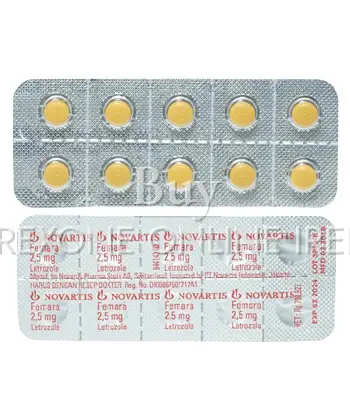
Could a medicine that lowers estrogen production help slow the growth of certain breast cancers? Femara is a brand name for letrozole, a targeted prescription medicine used in hormone receptor–positive breast cancer. It belongs to a class of drugs known as aromatase inhibitors (a type of medicine that reduces estrogen production in the body).
Letrozole interferes with the enzyme aromatase, which converts androgens into estrogens. In postmenopausal individuals, most estrogen is produced through this pathway, so reducing its levels can slow or stop the growth of tumors that depend on estrogen.
In Ireland, access to Femara may be subject to local prescribing rules. The medicine is prescribed by a clinician and dispensed by a pharmacist. The active ingredient, letrozole, is the same medicine in generic form as well as under the Femara brand.
Femara is typically taken as a daily tablet. The exact dose and duration depend on the individual’s cancer type, treatment plan, and response to therapy. A health professional will provide written instructions and timing suited to the patient’s needs.
Effectiveness and safety depend on adherence to the prescribed regimen and routine monitoring. If any questions arise about how Femara works, a clinician or pharmacist should be consulted for clarification.
Femara is used as part of systemic therapy for certain breast cancers that express hormone receptors. It is commonly used in postmenopausal individuals to treat hormone receptor–positive disease. The medicine may be employed as adjuvant therapy (after initial surgery or other treatments) or for specific metastatic scenarios, depending on clinical decisions.
The aim of therapy is to reduce the growth stimulus provided by estrogen, thus slowing disease progression and potentially improving outcomes. The clinical plan will consider menopausal status, disease stage, prior treatments, and other medical conditions.
Before starting Femara, the clinician will review the patient’s medication list for potential interactions and assess liver and bone health as needed. Regular follow-up appointments and laboratory monitoring are standard components of ongoing care.
Patients should be aware that not all breast cancers are hormone receptor–positive, and not all patients are candidates for letrozole. If uncertainty exists regarding eligibility, check the official leaflet or consult a healthcare professional.
The following steps provide a practical framework for initiating therapy with Femara. Each step should be interpreted in light of the individual treatment plan and local pharmacy practices.
Step 1: Confirm prescription and obtain patient information. A clinician determines the indication, duration, and dose. If a prescription is required, it should be presented to the dispensing pharmacist.
Step 2: Pharmacy pickup and verification. The pharmacist verifies the medication, checks for interactions with current medications and supplements, and confirms patient identity and dosing schedule. A patient information leaflet is provided.
Step 3: Start of therapy. Take the medication exactly as prescribed. Documentation of start date and any prior therapies helps with monitoring. A fixed daily schedule is commonly recommended to maintain consistent levels.
Step 4: Follow-up and adjustments. Routine follow-up with a clinician is arranged to assess response, tolerance, and any side effects. Adjustments to therapy occur only under professional guidance.
Femara is typically taken once daily as a single tablet. The timing should be established to fit daily routines and to maintain consistency.
In general, meals do not dramatically affect absorption, so dosing can be with or without food according to personal preference. It is best to take the tablet at approximately the same time every day.
If a dose is missed, take the missed tablet as soon as remembered only if there is a comfortable break before the next scheduled dose. If it is near the time for the next dose, skip the missed dose and resume the regular schedule. Do not double up to make up for a missed dose unless advised by a clinician.
Always store the medication in its original packaging and keep it out of reach of children. Do not alter the dosing schedule without consulting a healthcare professional.
Initial effects may take several weeks to become noticeable in terms of symptom changes and tumor response. Responses vary among individuals, and improvements can be gradual.
During the early period, common effects may include hot flashes, fatigue, or mild joint discomfort. These symptoms are monitored by the treating clinician and may be managed with supportive care measures if necessary.
Bone health and calcium balance may be considered during therapy, particularly if risk factors for osteoporosis are present. Screening or monitoring tests may be arranged as part of routine care.
Any new or worsening symptoms should be reported promptly to a clinician or pharmacist. Early communication supports safety and ongoing treatment decisions.
Regular monitoring is important to assess treatment response and tolerability. This may include clinical visits, imaging studies, and laboratory tests as indicated by the treatment plan.
Seek medical advice if any of the following occur: severe bone or joint pain, signs of bone health concerns, unusual bleeding or bruising, persistent abdominal pain, chest symptoms, or severe allergic reactions.
Emergency care should be sought for any signs of a medical emergency, such as severe breathing difficulty or chest pain. For urgent issues, contact a healthcare professional or go to the nearest medical facility.
Inform any healthcare providers about current medications, including over-the-counter drugs and supplements, to avoid interactions. A patient might be asked to discontinue certain medications during therapy if deemed necessary.
Store the tablets at room temperature, away from moisture and heat. Do not use after the expiration date printed on the packaging.
Keep the medication in its original container with the label intact to preserve proper identification and dosing information.
If a tablet is damaged or broken, handle it with care and seek advice from a pharmacist before reuse. Dispose of unused medication according to local guidelines.
Keep all medicines out of reach of children and away from pets. Do not share prescription medicines with others.
The safety profile of Femara is monitored by clinicians during therapy. Some effects are more common, while others may require medical attention.
Common issues can include hot flushes, fatigue, mild joint stiffness or pain, night sweats, or mood changes. Many of these symptoms improve with time or can be managed with supportive care.
Seek medical advice for severe or persistent symptoms, swelling of the legs, severe abdominal pain, or symptoms suggesting an allergic reaction, such as facial swelling or trouble breathing.
Serious but rare risks should be discussed with a clinician, who can provide guidance on monitoring and risk mitigation.
Contraindications are conditions or situations in which the medicine should not be used. The prescribing clinician will determine suitability based on medical history, current conditions, and concomitant medications.
Potential interactions with other medicines can occur. Provide a complete list of all prescription, over-the-counter medicines, vitamins, and herbal products to the clinician or pharmacist.
Some medicines may require timing adjustments or monitoring while on Femara, or may be avoided altogether. Always verify with a healthcare professional before starting any new drug.
Affected groups and considerations include certain cardiovascular, bone health, liver enzyme–altering drugs, and medications that influence estrogen pathways. If unclarity exists, check the official leaflet or consult a healthcare professional.
When travelling with Femara, ensure the tablets remain in their original packaging, carry a copy of the prescription, and keep medications in a carry-on bag where possible. Check local rules for carrying prescribed medicines across borders and during flights.
In case the daily timing is disrupted, return to the established schedule as soon as feasible. Do not alter the dosage without guidance from a clinician.
Interactions with common over-the-counter products should be reviewed. For example, nonsteroidal anti-inflammatory drugs, calcium supplements, or herbal products may interact with the medication. Consult a pharmacist before combining therapies.
Switching from a different breast cancer medicine to Femara requires medical supervision to ensure continuity of care and appropriate monitoring.
Noticeable improvement, if present, may be gradual and can depend on several factors, including cancer biology and prior treatments.
As a rule, tablets should not be split or crushed unless the prescribing clinician indicates compatibility for such administration.
Discuss any planned dental procedures or anesthesia with the treating team, as there may be implications for cancer therapies and bone health.
Pregnancy must be avoided during therapy and for a period after stopping treatment, as advised by a clinician. Breastfeeding while on Femara is generally not recommended unless specifically allowed by a clinician.
Can the medicine be used with alcohol? It is best to discuss with a clinician, as alcohol can interact with overall treatment plans and side effect management.
Storage guidance should be followed strictly, and unused medication should be returned to a pharmacy for safe disposal according to local guidelines.
If the patient misses a dose, the guidance provided by the clinician should be followed. Do not double up doses without professional advice.
Is it safe to take vaccines during Femara therapy? Vaccination decisions should be guided by a clinician based on medical history and current therapy.
What should be done if a dose is not available at the scheduled time due to supply issues? Contact the pharmacist or clinician for guidance on temporary steps and the timing of subsequent doses.
How long should one expect to remain on Femara? Treatment duration is individualized and depends on the clinical course and doctor’s plan. Check the official leaflet and consult a clinician for personalized timing.
Can dental work or routine checkups proceed without interruption? Routine care is generally possible, but any invasive dental procedures should be coordinated with the treating oncology team.
Is there a need for additional health checks, such as bone density tests? Depending on risk factors, clinicians may recommend bone health assessments and preventive measures.
If any questions arise about the suitability of Femara, or if symptoms develop that are concerning, consult a clinician or pharmacist for advice. The information here is not a substitute for professional medical guidance.
For residents of Ireland, access to Femara may depend on local prescribing rules and healthcare pathways. A clinician will determine eligibility, timing, and monitoring requirements within the Irish healthcare system.
Pharmacists in Ireland provide medication review, ensure drug interaction checks, and supply patient information leaflets. If questions arise about dispensing or administration, contact the local pharmacy for clarification.
Always inform the treating team about all medications and supplements in use, including any herbal products, to maintain safe and effective therapy.
In Ireland, a prescription may be required depending on local rules; verify with a clinician if there is any doubt about access or coverage under health service provisions.
14–21 days. Free from €178.51 .
5–9 days. €26.78
−10% when paying with cryptocurrency.
−10% on all repeat orders.
All orders are packed in neutral, unbranded boxes with no product name on the outside.